
Wondering whether conversion rate optimization is actually worth investing in?
The answer depends on more than your current conversion rate.
A small improvement can create a significant financial impact when a website already generates substantial revenue. On the other hand, if your website has very little traffic or the real problem is poor targeting, weak positioning, or an offer customers do not want, CRO may not be the first thing you should invest in.
Instead of asking:
“How much can CRO increase our conversion rate?”
Ask:
“If CRO works, will the additional value it creates be greater than what we spend?”
That is the real question.
Here are six things to consider before deciding whether CRO makes financial sense for your business.
01 Start With the Money, Not Just Your Conversion Rate
Two ecommerce businesses could both have a 2% conversion rate and still have completely different reasons to invest in CRO.
Imagine one website generates $1 million in annual online revenue while another generates $30 million. A 5% increase in revenue would represent:
- $50,000 for the first business.
- $1.5 million for the second business.
The conversion rate is identical, but the financial opportunity is completely different.
That is why looking at conversion rate alone does not tell you whether CRO is worth the investment.
Start by looking at the amount of revenue moving through the part of your customer journey that you can realistically improve.
For ecommerce businesses, consider:
Your Shopify analytics, GA4 or ecommerce platform can help you determine your current revenue. You should also understand your actual profit after direct costs such as product costs, shipping, discounts, payment processing and other expenses.
For SaaS and lead-generation businesses, the calculation may need to move further down the funnel:
The goal is to understand the financial opportunity before deciding how much CRO deserves to be invested.
How Much Does CRO Need to Produce to Be Worth It?
Imagine your website generates $10 million annually and your CRO investment is $150,000 per year. A 1.5% increase in revenue would produce another $150,000 in revenue.
But revenue is not the same as profit.
After product costs, shipping, payment fees and other direct expenses, the amount your business keeps will be lower. So one important question to ask your finance team is:
“If we generate another $100 in sales, approximately how much do we actually keep?”
That number gives you a much clearer picture of the improvement CRO needs to generate.
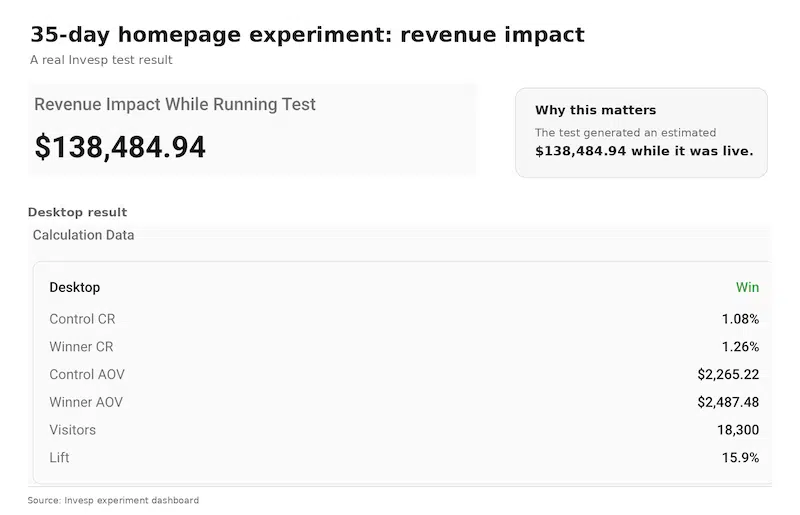
Do not evaluate an experiment only by asking whether the conversion rate increased. Look at the actual business outcome.
- Did revenue increase?
- Did profit increase?
- Did qualified leads increase?
- Did those leads become customers?
The objective is not simply to make a dashboard metric look better. The objective is to make the business more money.
02 Make Sure You Have Enough Traffic and Conversions to Learn
A/B testing works by comparing different versions of a page or experience.
But if only a small number of people visit your website or very few visitors convert, it can take a long time to gather enough evidence to make a reliable decision.
There is no universal traffic number that works for every business. The amount of data required depends on things such as:
- Your current conversion rate.
- The size of improvement you want to identify.
- The amount of traffic entering the test.
- The level of statistical confidence required.
This is important because a test that takes many months to produce a useful answer may not make commercial sense.
However, low traffic does not mean your website cannot be improved. It simply means that continuous A/B testing may not be the best place to start.
You can still use:
- Customer interviews
- Usability research
- Analytics analysis
- Session recordings
- Customer surveys
- Expert store audits
These methods can reveal obvious problems and help you make higher-confidence improvements without pretending that every change needs an A/B test.
03 Find Out Whether Your Website Is Actually the Bottleneck
CRO improves what happens after the right visitor reaches your website. It cannot create demand for a product people do not want.
Before making a major CRO investment, ask:
“Are enough of the right people reaching our website?”
If your business has just launched, has very little traffic, has not established product-market fit, or is sending poorly targeted advertising traffic to the website, acquisition or positioning may need attention first.
But if you already have meaningful traffic and visitors are disappearing at important points in the customer journey, CRO becomes much more interesting.
For ecommerce, examine the journey:
For SaaS businesses:
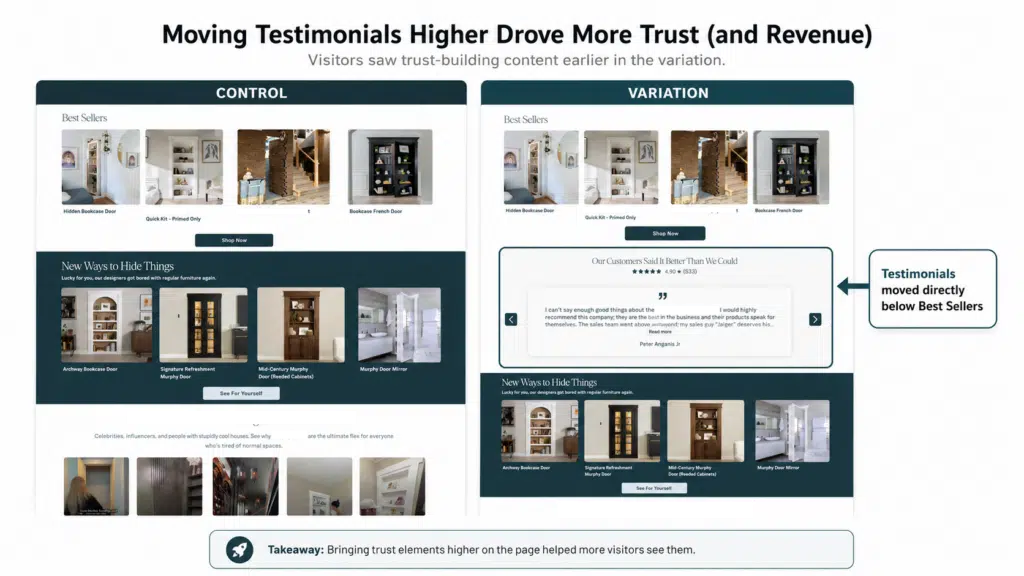
Instead of looking only at your overall conversion rate, identify exactly where potential customers are dropping out. That is where you can begin looking for revenue leaks.
Check Where Customers Are Dropping Off
Checkout is one obvious area to investigate. But the important question is not simply:
“Is our abandonment rate higher than the average?”
The better question is:
“Why are our customers abandoning the process, and can we actually fix those reasons?”
A high abandonment number by itself does not tell you what needs to change. You need to understand the behavior behind the number. That is where conversion research becomes valuable.
04 Ask How Much of Your Decision-Making Is Based on Guesswork
Many businesses have plenty of ideas about how to improve their website.
The problem is that having ideas is not the same as knowing which problems matter most.
You may hear suggestions such as:
- “Change the button.”
- “Move this section.”
- “Make the headline bigger.”
- “Add another popup.”
- “Change the product page.”
But what evidence supports those decisions?
A strong CRO process replaces assumptions with evidence. Instead of:
“We think this is the problem.”
You want to reach:
“Here is where customers are struggling, here is the evidence, and here is what we should fix or test first.”
That distinction can save your team significant time and development resources.
CRO is not simply about discovering a winning button color or changing a headline. It can also help your business understand:
- Where customers get confused.
- Where trust breaks down.
- Which information customers need before buying.
- Which parts of the journey create friction.
- Which improvements deserve development resources.
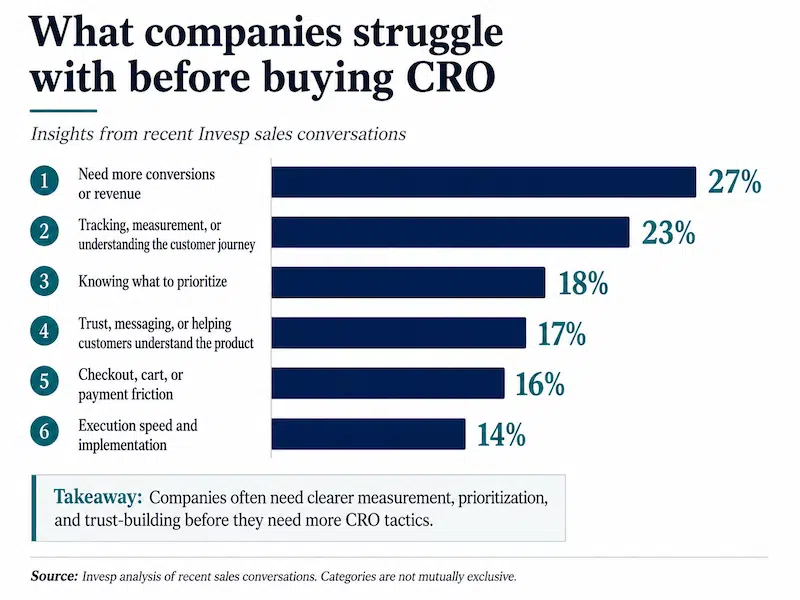
When your team has dozens of ideas but no reliable way to prioritize them, that prioritization itself can create significant value.
05 Make Sure Your Business Can Act on What It Learns
You can have enough traffic. You can identify serious conversion problems. You can calculate a significant financial opportunity.
But CRO can still fail to create value if your business cannot implement the improvements.
Ask yourself:
- Can your developers make the changes?
- Can experiments move through design, legal and brand approval?
- Can tracking and analytics problems be fixed?
- Can your team make decisions when the evidence disagrees with their original assumptions?
- What happens when a test produces a result that the internal team does not expect?
If every website improvement takes months to get approved, additional research alone will not solve the problem. CRO creates value when a business can act on what it learns.
Research without implementation creates reports. Research combined with action creates improvement.
06 Do Not Expect Every CRO Idea to Win
One of the biggest misconceptions about CRO is that you are paying for someone who already knows which change will increase conversions. That is not how good experimentation works.
You are investing in a process that helps your business:
- Find valuable opportunities.
- Test ideas before making large-scale changes.
- Reduce the risk of poor decisions.
- Prioritize improvements.
- Learn from customer behavior.
Sometimes the experiment wins. Sometimes it produces no meaningful improvement. Sometimes the result is negative.
A negative result can still be valuable.
Imagine your team believes a new website feature will improve the customer experience. Without testing, you build it, launch it to everyone and assume it worked. But what if the feature actually reduces revenue?
Testing gives you the opportunity to discover that before making the change permanent.
Sometimes the value of an experiment is not the revenue it creates. Sometimes the value is the money you avoid losing by not launching a bad idea.
So, Is CRO Worth It for Your Website?
A serious CRO program is more likely to make financial sense when you can answer yes to several of these questions:
- Does meaningful revenue already flow through the website?
- Would a relatively small improvement create meaningful financial value?
- Do you have enough traffic and conversions to learn from experiments?
- Are visitors dropping between important stages of your funnel?
- Do you know that customers are struggling but do not yet know exactly why?
- Is your team making website decisions primarily based on opinions?
- Can your business actually implement the improvements discovered through research?
- Can you reliably measure revenue, qualified leads or another meaningful business outcome?
If the answer to most of these questions is yes, CRO may be a strong investment.
When CRO May Not Be the First Priority
If you do not have enough traffic or conversions to run useful experiments, start by understanding what is preventing visitors from converting.
If your tracking is unreliable, fix measurement first.
If very few people are reaching your website, focus on acquisition.
If your product positioning is unclear, solve that problem before investing heavily in experimentation.
And if the economics show that you would need an unrealistic improvement just to recover the cost of the CRO program, it may not be the right investment yet.
The Whyte Team Takeaway
CRO is not about making a website look better just for the sake of design. It is about understanding what prevents visitors from becoming customers and making changes that improve the economics of your website.
The right question is not:
“Can we increase our conversion rate?”
The better question is:
“Where are we losing potential customers, why is it happening, and how much is fixing it worth?”
When you understand those three things, you can make smarter decisions about where to invest your time, money and development resources.
At Whyte Team, we help Shopify brands identify the conversion problems hiding inside their customer journey and determine what should be fixed first.