
Conversion rate optimization helps Shopify stores get more value from the visitors they already have by making the buying experience clearer, easier, and more trustworthy.
More traffic can create more opportunities, but traffic alone does not guarantee sales. If shoppers cannot understand a product, find the information they need, use the site comfortably on mobile, or complete checkout without friction, part of that traffic investment is lost. Shopify CRO finds those barriers and turns evidence into focused improvements.
This guide explains what conversion rate optimization is, how it works, what to optimize, and how a structured Shopify conversion optimization service can support sustainable growth.
What Is CRO? Understanding Conversion Rate Optimization
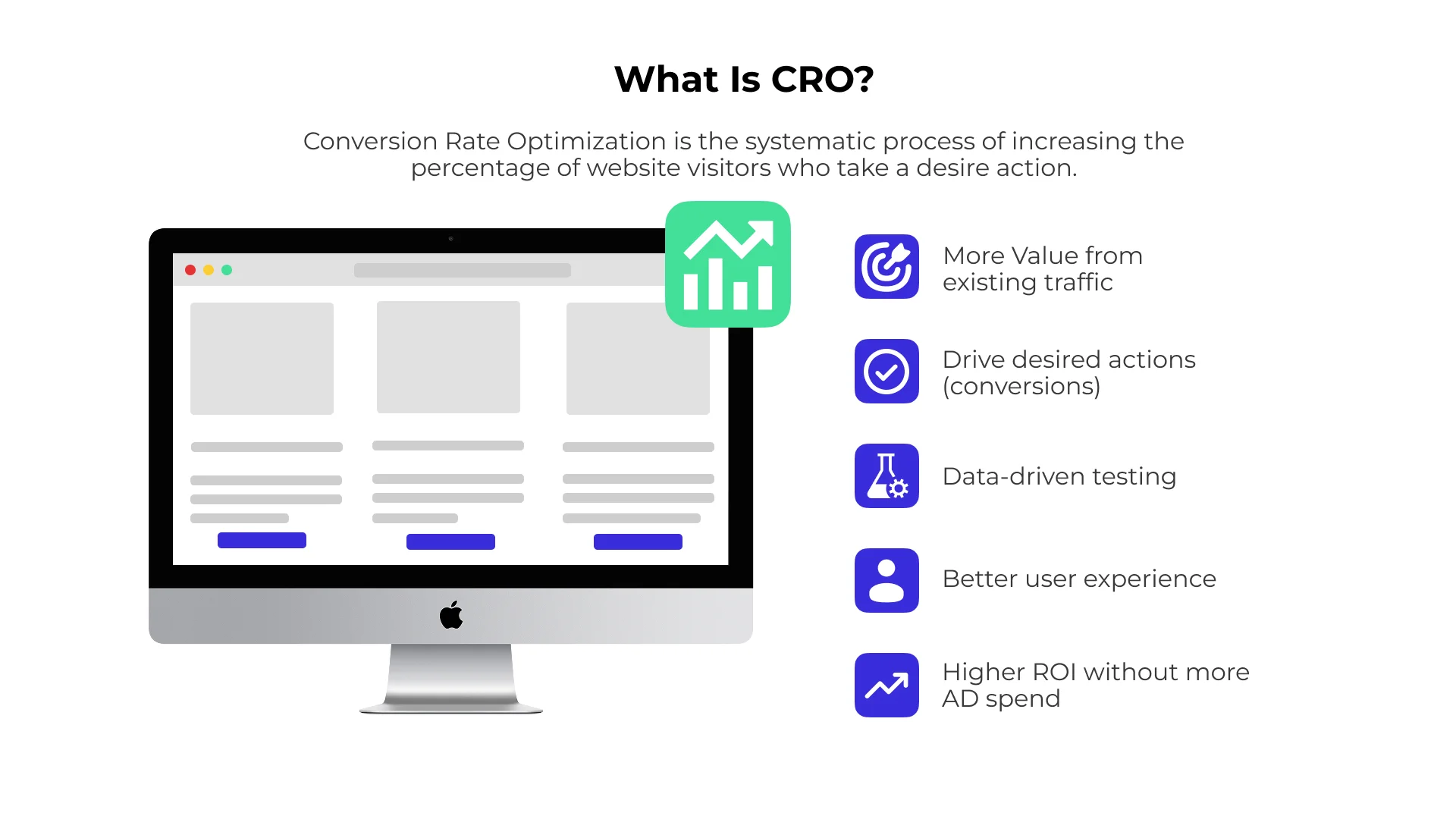
CRO stands for conversion rate optimization. It is the systematic process of improving a website so a higher percentage of visitors complete a desired action. A conversion could be a purchase, email signup, quote request, account creation, or another action that matters to the business.
For most Shopify stores, the primary conversion is a completed purchase. Supporting conversions—viewing a product, adding an item to cart, starting checkout, or joining a list—help reveal whether customers are progressing toward that purchase.
The calculation is simple, but useful Shopify conversion rate optimization goes beyond chasing a percentage. It asks whether the store is helping the right customers make informed decisions and whether improvements create meaningful revenue, profit, or customer value.
Why CRO Matters for Shopify Stores
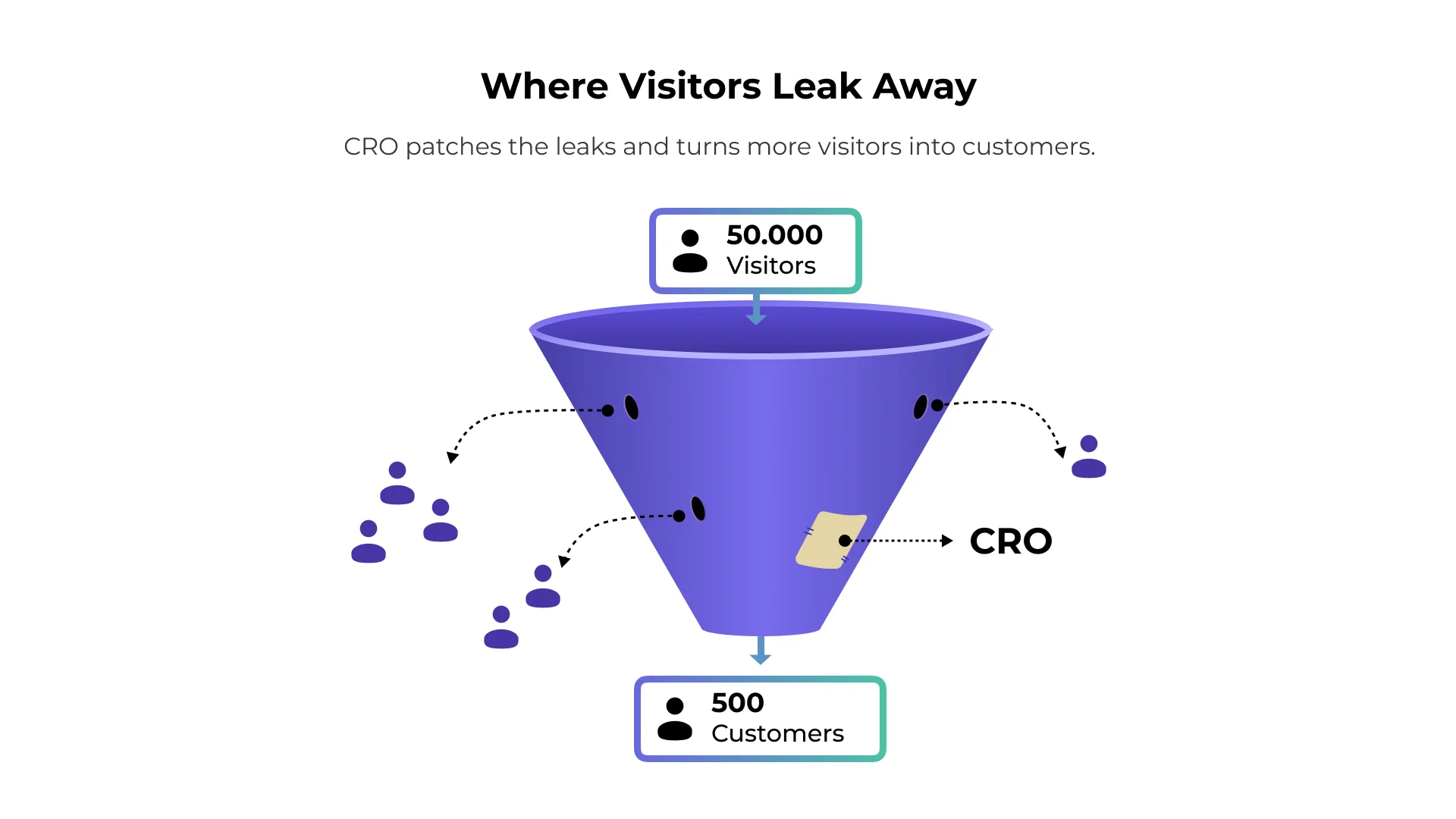
A store can invest in paid ads, SEO, creators, social media, and email while still losing potential customers after they arrive. Increasing traffic pours more people into the same experience; it does not repair unclear product pages, missing trust information, awkward navigation, or checkout friction.
Ecommerce CRO helps a business earn more from existing demand. If qualified shoppers are already visiting, improving the percentage who buy can increase sales without requiring the same proportional increase in ad spend. It can also improve the return from every acquisition channel because those visitors encounter a more effective store.
That does not mean every store should expect the same uplift. Product demand, traffic quality, pricing, margins, seasonality, and implementation all affect the opportunity. A professional Shopify CRO audit should identify the store’s specific problems rather than applying a generic checklist.
CRO Is About More Than Changing Buttons
Button colors and headlines can be tested, but CRO is not a collection of visual tricks. Website conversion optimization studies the whole decision experience and the questions a customer must resolve before buying.
A complete review may examine:
- User behavior: how people move, hesitate, compare, and leave.
- Website usability: whether important tasks are easy on every device.
- Product pages: whether the offer, benefits, variants, imagery, and delivery details are clear.
- Calls-to-action: whether the next step is visible and matches customer intent.
- Trust signals: reviews, guarantees, policies, credentials, and proof.
- Navigation: how quickly shoppers can find the right category or product.
- Cart and checkout: unexpected costs, errors, payment choices, and unnecessary effort.
- Mobile experience and page speed: whether the journey remains usable under real conditions.
- Customer concerns: the objections and unanswered questions behind hesitation.
Good Shopify store optimization does not begin with “What should we change?” It begins with “What is making this decision difficult for the customer?”
Understanding Why Visitors Don’t Convert
Quantitative data shows what is happening. Analytics and funnel reports can identify pages with high exits, weak add-to-cart rates, device gaps, or a sharp checkout drop. This helps locate the part of the journey that deserves attention.
Qualitative evidence helps explain why. Customer interviews, on-site surveys, support questions, heatmaps, usability tests, and session recordings can reveal confusing language, missing details, failed interactions, or trust concerns that a dashboard cannot explain by itself.
Neither source should be used in isolation. A high exit rate does not prove that a page is bad, and one unusual session recording does not prove that every visitor has the same problem. Strong conversion optimization combines patterns from both sources before deciding what to fix or test. Our guide to website testing and conversion barriers explains these research methods in more detail.
The CRO Process: From Research to Improvement
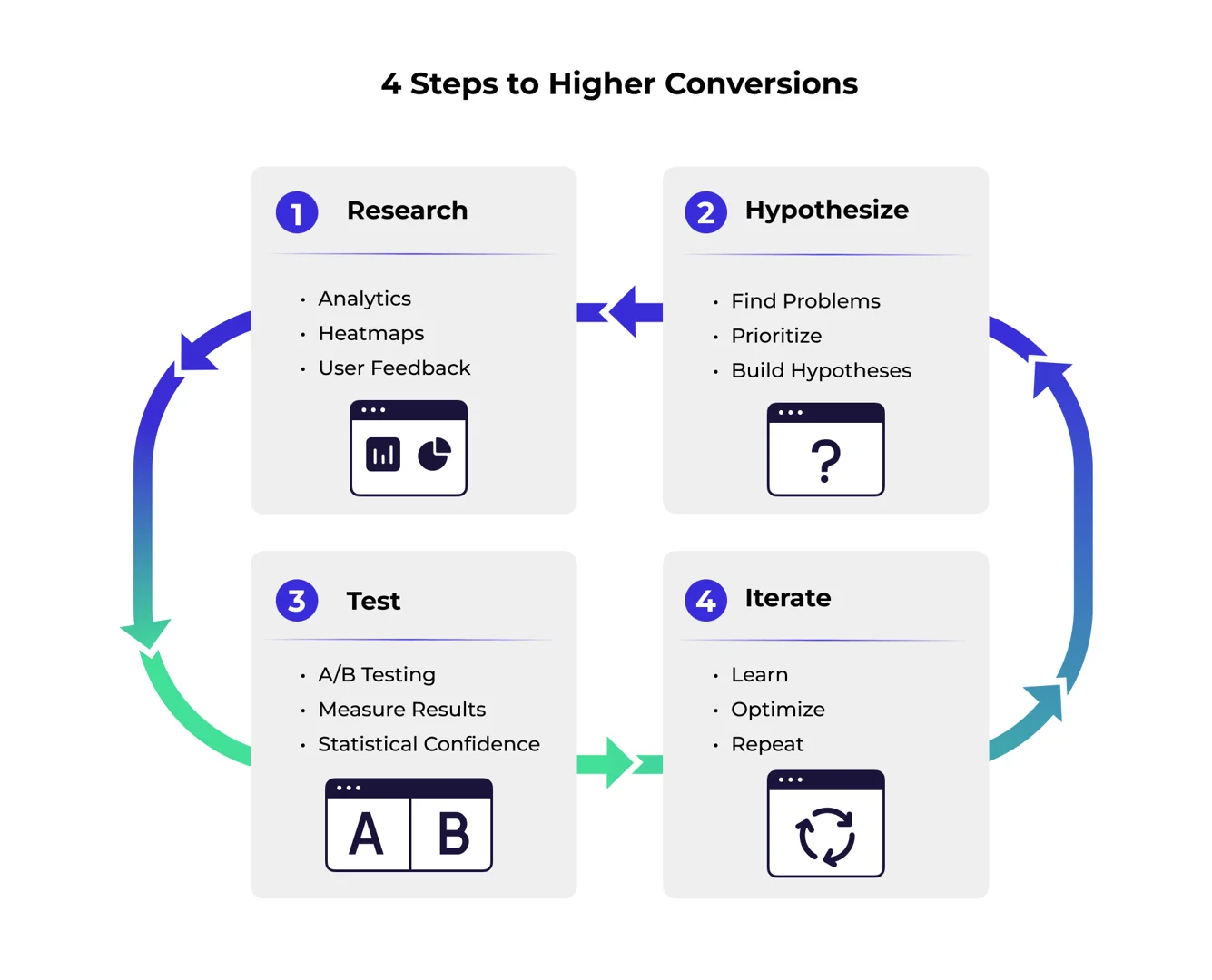
CRO is a continuous learning cycle, not a one-time website redesign. Each round should improve the store or improve the team’s understanding of its customers.
- Research and data analysis. Check tracking, review funnel performance, and collect behavioral and customer evidence.
- Identify conversion problems. Find the most important points of friction and separate evidence from opinion.
- Build testable hypotheses. State the observed problem, proposed change, expected behavior, and business outcome.
- Test and implement changes. Run an experiment when traffic and risk justify it, or directly correct verified usability and technical issues.
- Analyze results. Evaluate purchases, revenue, profit, qualified behavior, and unintended effects—not only clicks.
- Continue improving. Document the learning, monitor the journey, and use the evidence to choose the next priority.
Not every store needs an A/B test for every change. Low-traffic stores can still learn through customer research, usability testing, analytics reviews, and a focused CRO audit. The method should fit the question, available evidence, traffic, and cost of making the wrong decision.
What Should You Optimize on a Shopify Store?
Start with the journey closest to revenue and work outward. The best priority is not necessarily the page with the most design problems; it is the barrier with meaningful impact and strong evidence behind it.
- Homepage: clarify the offer, audience, product paths, and reasons to trust the brand.
- Collection pages: improve filtering, product comparison, merchandising, and findability.
- Product pages: strengthen product information, benefits, images, variants, sizing, delivery, returns, and calls-to-action.
- Navigation: reduce the effort required to reach the right product or information.
- Cart: make totals, shipping expectations, discounts, and the next step clear.
- Checkout: remove avoidable errors and distractions while supporting suitable payment and delivery options.
- Forms: ask only for useful information and make validation easy to understand.
- Trust signals: place reviews, social proof, guarantees, and policies where uncertainty occurs.
- Mobile experience: test touch targets, sticky elements, keyboards, media, and content order on real devices.
- Page speed: reduce delays and layout shifts without removing information customers need.
This is where specialist Shopify product page optimization and checkout conversion optimization can be useful: the work connects individual page changes to the complete conversion funnel.
CRO and Customer Psychology
Conversion decisions are influenced by how information is presented and how safe, relevant, and urgent the choice feels. CRO can use established decision principles responsibly:
- Social proof reduces uncertainty through genuine reviews and customer examples.
- Authority shows credible expertise, qualifications, testing, or independent recognition.
- Urgency and scarcity help when a deadline or limited quantity is real and clearly explained.
- Framing makes the value, comparison, and consequences of a choice easier to understand.
- Loss aversion acknowledges what a customer may miss, waste, or risk by delaying a useful decision.
These principles should support informed choices, not manipulate customers. Fake countdowns, invented stock warnings, hidden conditions, and misleading claims may create short-term action while damaging trust, retention, and the brand. Sustainable ecommerce conversion rate optimization makes the truth easier to see.
CRO vs SEO: What’s the Difference?
SEO helps qualified visitors discover a website in search results. CRO focuses on what happens after those visitors arrive. Search optimization can bring more relevant traffic; Shopify conversion optimization helps that traffic understand the offer, navigate the store, and buy with confidence.
They work best together. Ranking for the wrong intent will not create valuable customers, while earning the right visit and sending it to a confusing page wastes the opportunity. Search content should answer the visitor’s question, then guide them naturally toward the most relevant next step.
How Do You Know If Your Store Has a Conversion Problem?
Practical warning signs include:
- Traffic is growing but sales are not keeping pace.
- Product pages receive visits but produce few add-to-carts or purchases.
- Cart or checkout abandonment is high for your own normal customer journey.
- Visitors leave commercially important pages quickly.
- Customers repeatedly ask questions the website should already answer.
- Mobile visitors convert much more poorly than expected.
- Paid campaigns bring relevant clicks but weak revenue.
- The team has many ideas but no evidence-based way to prioritize them.
These are signals to investigate, not automatic diagnoses. A Shopify CRO agency should validate tracking, segment the data, study the experience, and identify the causes before recommending changes. See our client results for examples of the work, learn more about Whyte Team, or request a store review when you want an outside perspective.
Frequently Asked Questions
What does CRO stand for?
CRO stands for conversion rate optimization. It is the process of improving a website so a greater proportion of its visitors complete a valuable action, such as making a purchase, joining a list, or requesting a quote.
What is CRO in ecommerce?
Ecommerce CRO uses customer research, analytics, usability improvements, and testing to make an online buying journey clearer and easier. The goal is to help more qualified visitors become customers without relying only on more traffic.
What is Shopify CRO?
Shopify CRO is conversion rate optimization applied to a Shopify store. It can include product page optimization, navigation improvements, cart and checkout optimization, mobile usability, trust signals, speed, and measurement.
How does conversion rate optimization work?
It starts with research and reliable data. A team identifies where visitors struggle, builds a testable explanation for the problem, makes or tests a focused change, measures the outcome, and uses what it learns to guide the next improvement.
What is a good Shopify conversion rate?
There is no universal Shopify conversion-rate benchmark that every store should target. Results vary by industry, product price, traffic source, device, market, customer intent, and the conversion being measured. Your own trend and economics are usually more useful than a broad average.
What is the difference between SEO and CRO?
SEO helps relevant people discover and visit a website through search. CRO focuses on what those visitors experience after they arrive and how effectively the site helps them take the next step. Strong stores use both together.
How can I improve my Shopify conversion rate?
Begin with accurate tracking and review the complete buying journey. Combine funnel data with customer feedback, recordings, surveys, and usability observations. Prioritize the clearest barriers, improve them, and measure the result rather than changing many things at once.
When should a Shopify store invest in CRO?
CRO becomes especially useful when a store already attracts qualified traffic but loses too many visitors on product pages, in the cart, or during checkout. A CRO audit can also help when the team has many improvement ideas but little evidence about what to prioritize.